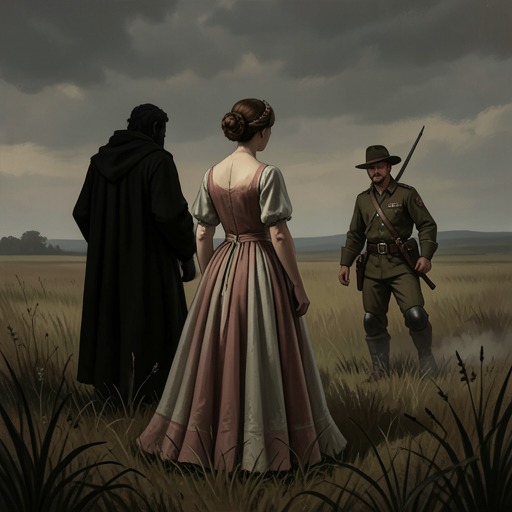
Troy’s sword exercise and kiss with Bathsheba
Far from the Madding CrowdSergeant Troy’s sword exercise and kiss with Bathsheba is the encounter that turns her attraction into an acknowledged, consuming infatuation. In a secluded hollow among the ferns, Troy makes a promised display of swordsmanship into an intimate performance: Bathsheba is at once its audience and its chosen participant. His display ends with a lock of her hair kept as a token and a kiss that leaves her shaken. The scene’s progression from spectacle to personal contact makes it a turning point in her feelings, and the narrator connects it to her later failure to weigh those feelings against her judgment.
The Meeting in the Ferns
On a midsummer evening at eight o’clock, Bathsheba enters an uncultivated tract on the hill opposite her dwelling, where tall, newly grown ferns surround a naturally formed hollow. At first she turns back, unwilling to remain near the meeting place. But after seeing Troy’s red uniform disappear around the rise, she waits, thinks of his disappointment if she fails to keep their engagement, and runs back to the hollow. Her return makes visible the conflict between hesitation and desire: she is trembling and breathless, yet decides she must go through with the meeting.
The hollow is a shallow, saucer-shaped pit about thirty feet across, encircled by ferns and carpeted with moss and grass. Its seclusion gives the encounter a space apart from farm and household routines, while the evening sun remains bright enough to illuminate Troy’s weapon and movements. He helps Bathsheba down the slope and begins the promised demonstration, explaining the cuts and thrusts through familiar agricultural motions such as sowing, hedging, reaping, and threshing. The lesson draws its language from her working world even as its subject belongs to his military skill.
A Performance of Skill and Risk
Troy moves from the formal sequence of cuts and thrusts to a faster, freer display. He asks Bathsheba to stand in front of him and says he will miss her by a hair’s breadth; she agrees to remain in place. The performance is calculated to make danger appear close while presenting Troy as fully in control. Bathsheba is startled when the sword seems to pass through her side, but Troy tells her that he has not touched her and explains the feat as sleight of hand. Her fear does not end the scene: reassured, she stays for the continuing display.
The sword’s speed and reflected light make the exercise seem to surround Bathsheba, while Troy’s movements remain governed by precision. He cuts off an outer lock of her hair without her flinching, then turns her attention to a caterpillar on her bodice and removes it with the point of the blade. When Bathsheba discovers that the sword is sharp, Troy admits that he had called it blunt to keep her still, explaining that her movement would have made the performance riskier. The incident establishes both the danger she had not understood and the confidence Troy places in his own dexterity. The scene’s tension rests on that imbalance: Bathsheba consents to a spectacle whose risks and methods she does not fully know.
The Token and the Kiss
After the demonstration, Bathsheba sits, overwhelmed by the scene. Troy picks up the severed lock of hair, winds it around his fingers, and places it inside his coat. She feels unable to refuse him. The lock turns the performance into a personal exchange: what began as a display of swordsmanship leaves Troy carrying away a part of Bathsheba’s appearance as a remembrance of their meeting.
Troy says he must leave, draws near again, and kisses her. The narration marks the kiss’s immediate effect through Bathsheba’s physical and emotional response: her face flushes, she feels aflame, and tears follow. She experiences the moment as though she has committed a grave wrong. The kiss is therefore not simply an affectionate conclusion to the meeting; it brings attraction, alarm, and guilt together, making the encounter a decisive change in the emotional stakes between them.
Bathsheba’s Infatuation and Its Contrast
The narrator describes folly as entering Bathsheba’s character through her love for Troy, although it is not presented as her essential nature. Bathsheba has too much understanding to be governed entirely by emotion, but too little experience of this condition to put that understanding to its best use. She allows impulse to guide her and does not undertake the careful moral inquiry that might have checked her feelings. The scene in the hollow gives that analysis a concrete beginning: she returns despite her hesitation, remains through the sword display, and cannot bring herself to resist Troy’s claim to the lock of hair.
The account distinguishes the surface qualities that draw Bathsheba to Troy from the less visible virtues associated with Gabriel Oak. Troy’s faults lie beneath the surface, while his attractions are immediately apparent; Oak’s shortcomings, by contrast, are easy to see, and his virtues are compared to metals hidden in a mine. Bathsheba has spoken freely to Liddy about her interest in Boldwood, but has kept her feelings for Troy within herself. Oak perceives her infatuation and is troubled by it, particularly because he sees her becoming entangled while Boldwood is away. Thus the kiss’s consequences extend beyond the two people in the hollow: it sharpens the contrast between love and respect and deepens Oak’s concern for Bathsheba.
Narrative Significance
The encounter changes the apparent meaning of Troy’s promised sword lesson. Its sequence—Bathsheba’s return, her participation in the demonstration, the severed lock, and the kiss—moves from courtship through spectacle to emotional surrender. The fern-ringed hollow briefly removes the pair from the ordinary social world, but the narrator’s subsequent account restores the wider consequences by placing Bathsheba’s response within her established character, her private feelings, and Oak’s watchful concern.
The scene also establishes the danger of confusing mastery of a performance with trustworthiness in a relationship. Troy controls the weapon and the pace of the demonstration; Bathsheba relies on his assurances while discovering that he has concealed the sword’s sharpness. The narrator does not treat this as proof of injury, but as part of the encounter’s imbalance and allure. By the time Troy leaves with her lock of hair and the kiss has unsettled her, the scene has set in motion the contrast that governs the following account: Bathsheba’s powerful but insufficiently examined love for Troy against the steadier, more openly legible virtues she associates with Oak.